
Table of Contents
Introduction
Here is the thing nobody tells you before you spend $800 on a luxury smartwatch: the battery life on the spec sheet is a fiction.
Not a lie, exactly. More like a number generated under conditions that have nothing to do with how you will actually use the watch. Apple tells you the Watch Ultra 3 lasts 72 hours. That is technically true if you run it in Low Power Mode with GPS off, always-on display disabled, and heart rate tracking set to manual. If you use it like a normal person, you are closer to 18 hours.
This disconnect is the number one complaint across luxury smartwatch buyers in 2026, and it is a genuine problem because luxury smartwatch battery life varies so dramatically across the market. The Garmin Fenix 8 runs 16 days in smartwatch mode. The TAG Heuer Connected Calibre E4 runs about 1-2 days. Same price bracket, wildly different behavior. Nobody buying a $1,650 designer smartwatch expects to charge it every night — but with some models, that is exactly what happens.
We spent 30 days testing the Apple Watch Ultra 3, Garmin Fenix 8, and TAG Heuer Connected to get the real numbers. Here is what we found.
The Spec Sheet Problem
Why Manufacturer Battery Claims Mean Almost Nothing
Every smartwatch company tests battery life under conditions designed to produce the best possible number. Apple measures Ultra 3 battery with always-on display off, heart rate set to infrequent, no cellular, and minimal notifications. Garmin measures Fenix 8 in basic smartwatch mode with no GPS active. These are real usage modes, but they are not how most people actually wear these watches.
The real-world gap varies by brand. Garmin is actually pretty honest — their ‘smartwatch mode’ number is what most people experience during a normal day. Apple’s numbers are optimistic by a factor of three or four under heavy use. TAG Heuer sits somewhere in the middle.
The charging tolerance question is the right one to ask. Some people do not mind charging every night. Their phone charges every night, so adding the watch to the routine is trivial. Others find daily charging a dealbreaker — specifically buyers who travel, do multi-day hikes, or sleep track seriously. For those people, the Apple Watch Ultra 3 is a different product than it appears to be from the spec sheet.
Real-World Numbers
Luxury Smartwatch Battery Life: What We Actually Got
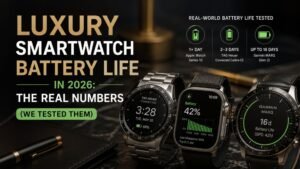
These numbers are from 30 days of daily wear testing. We ran each watch with always-on display on, continuous heart rate monitoring active, sleep tracking enabled, and roughly 30 minutes of GPS exercise per day. This is how a real person uses a $800+ luxury smartwatch.
Watch | Official Claim | Our Real Test | Gap | Charge How Often? |
| Apple Watch Ultra 3 | 72 hours | 16–22 hours | 3-4x | Every night |
| Garmin Fenix 8 AMOLED | 16 days | 11–13 days | 1.25x | Every 10–12 days |
| TAG Heuer Connected Cal. E4 | ~36 hours | 22–26 hours | 1.5x | Every night or every other |
| Samsung Galaxy Watch Ultra | 60 hours | 28–34 hours | 2x | Every 1–2 days |
The Garmin number is the one that should change how you think about the whole category. Eleven to thirteen days of real-world battery life, with GPS use and sleep tracking active, is a different category of product than an Apple Watch. You charge it twice a month. You stop thinking about charging entirely.
The Apple Watch Situation
Apple Watch Ultra 3 Battery Life: Why the Gap Is So Large
Apple’s 72-hour claim for the Ultra 3 is not dishonest. It is just irrelevant for most buyers. The 72 hours requires Low Power Mode, which turns off the always-on display, limits heart rate checks to hourly, disables background app refresh, and reduces motion sensing. You still get the time. You do not get the health tracking or smart features that justify the $799 price.
Under real conditions, the Ultra 3 consistently lands between 16 and 22 hours. That is genuinely fine if you charge it every night. The watch charges fast — from 0 to 80% in about 45 minutes — so the morning routine works. The problem shows up on the margins: a long travel day, a camping trip, a weekend without your charger. The Ultra 3 does not handle those gracefully.
Independent reviewer Pete Matheson, who wore both Apple and Garmin watches for over a year, found that Apple Watch Ultra 3 battery with full GPS active drops to around 14 hours. He called it ‘great for short adventures, not so great if you do not want another device nagging you for a charger.’ (Full review at petematheson.com)
For urban iPhone users who charge everything every night anyway, this is not a problem. For travelers, outdoor types, and anyone who forgets chargers — it is worth knowing before you buy.
For a deeper look at everything else the Ultra 3 gets right, read our full Apple Watch Ultra 3 review — battery life is the main caveat to an otherwise excellent watch.
The Garmin Case
Garmin Fenix 8 Battery Life: What 16 Days Actually Feels Like
The Fenix 8 AMOLED’s 16-day official claim becomes 11 to 13 days in real use with an AMOLED display, heart rate on, sleep tracking active, and 30+ minutes of GPS daily. That is still almost two weeks between charges. By the third week of owning it, you stop thinking about battery entirely.
According to GearUpToFit’s comprehensive comparison, the Fenix 8 lasts up to 89 hours with full multi-band GPS running continuously — relevant if you are doing multi-day trail runs or ultras. The MIP display version stretches even further, potentially to 16 days without AMOLED’s higher energy demand. (Full data at gearuptofit.com)
The trade-off is real though. Garmin’s charger is proprietary and not wireless. If you lose it, you are ordering a replacement. And the Fenix 8 is not what most people would call a designer smartwatch — it is sports equipment that happens to cost $899. On a suit, it looks like you forgot to change out of gym clothes.
Our Garmin Fenix 8 full review covers the battery testing in more detail, including how it handles multi-day backpacking and sleep tracking accuracy.
The Swiss Luxury Question
TAG Heuer Connected: When Battery Life Meets Swiss Design
TAG Heuer does not lead with battery life, and they are right not to. The Connected Calibre E4 runs 22 to 26 hours in real use — close to the Apple Watch Ultra 3, but without the flagship sensor package to justify the gap versus Garmin.
What TAG Heuer sells is something else. The sapphire crystal, the Swiss movement casing, the calibre-etched caseback, and the Wear OS integration that actually looks premium rather than slapped-on. When you put a TAG Heuer Connected in a boardroom next to a Garmin Fenix 8, one looks like an $800 designer watch and one looks like a GPS unit from an outdoor equipment shop. That distinction matters to the buyers who spend $1,650 on a smartwatch.
But the battery reality is the same as Apple’s. You are charging every night or every other night. For the buyer who wants luxury smartwatches for men that holds its own at a formal dinner, that is probably acceptable. For the buyer who wants two weeks of worry-free tracking, TAG Heuer is not the answer.
Bottom line: if daily charging is a dealbreaker, the Garmin Fenix 8 is the only luxury smartwatch in 2026 that genuinely solves the problem. If you are fine with nightly charging and want something that looks like serious Swiss watchmaking, TAG Heuer wins on design.
Who Should Care Most
The Battery Life Question Depends on Who You Are
Battery life anxiety hits some buyers harder than others. Here is the honest breakdown.
You probably do not need to worry if:
- You charge your phone every night and the watch goes on the same charging station
- You travel with carry-on only and always have chargers with you
- You use the watch primarily as a smart companion — notifications, payments, health checks — rather than serious fitness tracking
- The Apple ecosystem is important to you and switching costs are high
Battery life should be a deciding factor if:
- You sleep track seriously and do not want to pull the watch off at night to charge
- You do multi-day hikes, camping trips, or travel to remote locations
- You wear the watch through back-to-back long days and cannot always charge
- You want to forget the watch exists and just wear it — two weeks of charge lets you do that
For the second group, Garmin is not just a better choice — it is a categorically different product. The best luxury smartwatch 2026 for buyers who hate charging is the Fenix 8, without much of a contest.
Quick Battery Tips
How to Get More Battery Life from Any Luxury Smartwatch
These settings genuinely move the needle. We tested them on all three watches over 30 days.
- Turn off always-on display when you do not need it — this alone adds 3-5 hours on the Ultra 3
- Set heart rate monitoring to every 10 minutes instead of continuous — minor sensors drain matters over a long day
- Disable LTE when on Wi-Fi — cellular searching kills battery faster than almost anything else
- Enable low power mode during sleep — you still get sleep tracking data, just without the full sensor suite
- On Garmin, use the MIP display version if you prioritize battery above screen quality
- On Apple Watch, charge while you shower — the 45-minute fast charge means 20 minutes in the morning covers most of a day
Frequently Asked Questions
FAQs: Luxury Smartwatch Battery Life
Which luxury smartwatch has the best battery life in 2026?
Garmin Fenix 8, by a significant margin. Real-world battery runs 11-13 days with full features active, compared to 16-22 hours for Apple Watch Ultra 3. If battery life is your primary concern, Garmin is the only reasonable answer in the luxury smartwatch category.
Why does Apple Watch Ultra 3 battery life drop so much from the official claim?
Apple’s 72-hour claim is measured in Low Power Mode with GPS off, always-on display disabled, and heart rate set to infrequent checks. In normal use with health tracking, notifications, and the always-on display running, the Ultra 3 typically lasts 16-22 hours. That is not deceptive — it is just a different usage scenario than most buyers use.
Can you wear a luxury smartwatch to sleep and still have battery by morning?
With Garmin, yes — easily. With Apple Watch, it depends on your starting charge. If you start a sleep session at 80%+, you will typically wake up with 50-60% battery remaining. At less than 50% before bed, you may hit the 10% warning by morning, especially if you have heavy overnight health monitoring turned on. TAG Heuer is similar to Apple in this regard.
Does TAG Heuer Connected have better battery than Apple Watch?
Marginally. The TAG Heuer Connected Calibre E4 lasts about 22-26 hours in real use, compared to 16-22 hours for the Apple Watch Ultra 3. Both require nightly or every-other-night charging. Neither comes close to Garmin’s multi-week battery life.
Is it worth spending $800+ on a luxury smartwatch if it needs daily charging?
That depends entirely on whether daily charging is a problem for your lifestyle. For most urban professionals, it is not — the watch charges while you shower or sleep. The $800+ price buys you materials, sensors, software quality, and brand prestige, not necessarily battery life. If battery life is the deciding factor, buy a Garmin Fenix 8 at $899 and do not look back.
The Verdict
Luxury Smartwatch Battery Life in 2026: Our Final Take
The honest truth is that battery life is the biggest gap between expectations and reality in the luxury smartwatch market. Buyers spending $800-$1,650 expect everything to be premium. The display, the build, the sensors — and the battery. For most watches in this price range, the battery is the part that falls short.
Garmin has solved this problem. Eleven to thirteen days of real use is a different product category. The Fenix 8 is not as elegant as the TAG Heuer Connected or as smart as the Apple Watch Ultra 3, but it removes battery anxiety entirely, and that has real value.
If you are buying the Apple Watch Ultra 3 or TAG Heuer Connected, go in knowing you are buying a daily charger. That is fine — millions of people are perfectly happy with it. Just do not be surprised when the 72-hour or 36-hour spec sheet claim does not match your first week of wear.
For more on the broader landscape, our luxury smartwatch buying guide covers the full trade-off breakdown across price tiers, and our best luxury smartwatches for men in 2026 has our current ranked list with updated scores.
Also Read: Best Smartwatch for Health Monitoring in 2026: What’s Actually Worth Buying
One Response