
Published: May 2026 | Category: Running Smartwatches | Author: Watch Buddy Editorial
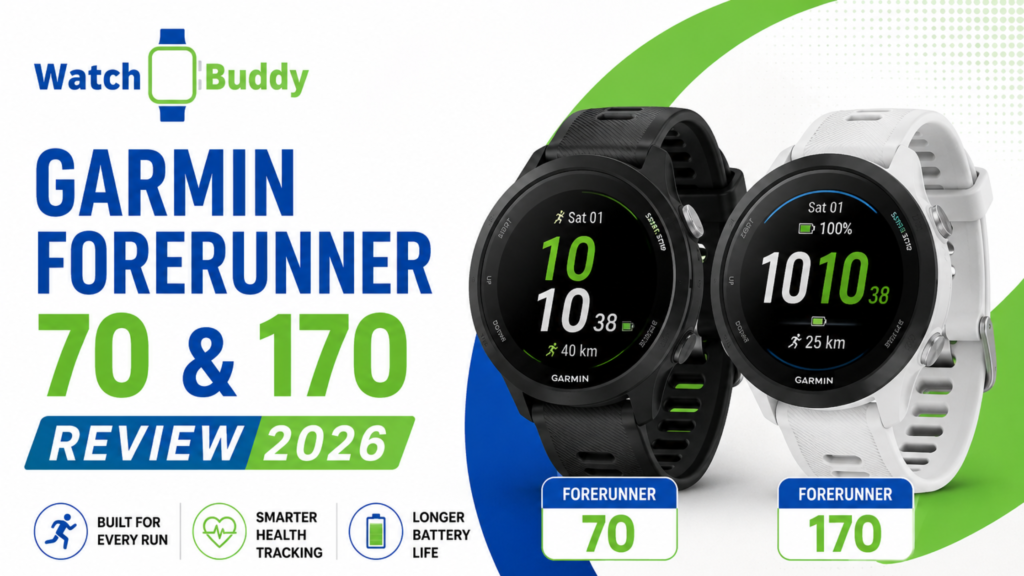
Table of Contents
Garmin Forerunner 70 and 170 Review: The Best Entry-Level Running Smartwatches in 2026?
Garmin Forerunner 70 and 170 Review — that phrase “best entry-level running smartwatch 2026” is everywhere in running circles right now, and for good reason. Garmin dropped both watches on May 15, 2026, replacing the long-running Forerunner 55 and 165 with two new devices that push premium training tools down to the entry level. If you’ve been waiting for a Garmin running watch that doesn’t cost $500 but still delivers serious coaching smarts, these two are the most compelling options the brand has ever offered at this price point.
This review covers everything: hardware, software, battery, and a detailed comparison against the Coros Pace 3, Apple Watch SE 2nd Gen, Polar Pacer, and Amazfit Cheetah Lite. Pricing, pros, cons — it’s all here. By the end, you’ll know exactly which watch belongs on your wrist.
1. What Are the Garmin Forerunner 70 and 170?
Garmin’s Forerunner line has always been about running first. The Forerunner 70 ($249.99) and Forerunner 170 ($299.99; $349.99 for the Music edition) sit at the bottom of that lineup in 2026 — but “bottom” now means something very different than it did two years ago.
Both watches share a 43mm fiber-reinforced polymer case, a 1.2-inch AMOLED touchscreen with 390×390 resolution, five physical side buttons, and Garmin’s Elevate Gen 4 heart rate sensor. From a distance, they’re identical. The differences are in the sensors, payment support, and sport profiles — check the full specs comparison below for the complete breakdown.
The Forerunner 70 is the stripped-back option. It skips the barometric altimeter, Garmin Pay, cycling power meter support, and open-water swimming. The Forerunner 170 adds all of those, plus a compass, gyroscope, and thermometer. The Music edition layers on 4GB of onboard storage for phone-free listening.
What both watches share is the full Garmin physiological stack — Training Readiness, HRV Status, Training Load, Training Status, VO2 Max, wrist-based Running Power, Running Dynamics, and the adaptive Garmin Running Coach. Getting all of that at $249.99 is the headline. See training features for the deep dive.
Also Read: Best Smartwatch for Android in 2026
2. Garmin Forerunner 70 vs 170 — Full Specs Comparison
| Feature | Forerunner 70 | Forerunner 170 | Forerunner 170 Music |
| Price (US) | $249.99 | $299.99 | $349.99 |
| Case Size | 43mm | 43mm | 43mm |
| Case Material | Fiber-reinforced polymer | Fiber-reinforced polymer | Fiber-reinforced polymer |
| Display | 1.2-in AMOLED, 390×390 | 1.2-in AMOLED, 390×390 | 1.2-in AMOLED, 390×390 |
| Touchscreen | Yes + 5 buttons | Yes + 5 buttons | Yes + 5 buttons |
| Water Resistance | 5 ATM (50m) | 5 ATM (50m) | 5 ATM (50m) |
| Weight | ~40g | ~43g | ~43g |
| HR Sensor | Elevate Gen 4 | Elevate Gen 4 | Elevate Gen 4 |
| GPS | Multi-GNSS (single-band) | Multi-GNSS (single-band) | Multi-GNSS (single-band) |
| Barometric Altimeter | No (GPS only) | Yes | Yes |
| Compass / Gyroscope | No | Yes | Yes |
| Thermometer | No | Yes | Yes |
| Garmin Pay | No | Yes | Yes |
| Onboard Music | No | No | Yes (4GB) |
| Open Water Swim | No (pool only) | Yes | Yes |
| Battery: Smartwatch | Up to 13 days | Up to 10 days | Up to 10 days |
| Battery: GPS Only | 23 hours | ~20 hours | ~20 hours |
| Battery: All-Systems GPS | 16 hours | 14 hours | 14 hours |
| Sports Apps | 80+ | 80+ (more profiles) | 80+ (more profiles) |
| Training Readiness | Yes | Yes | Yes |
| HRV Status | Yes | Yes | Yes |
| VO2 Max (Running) | Yes | Yes | Yes |
| Cycling Coach | No | Yes | Yes |
| Multisport / Triathlon | No | No | No |
| ECG / Skin Temp | No | No | No |
| Quick Workouts | Yes | Yes | Yes |
| Garmin Connect App | Yes | Yes | Yes |
| Connect IQ Apps | Yes | Yes | Yes |
3. Design and Build Quality
Both watches are light. Genuinely, put-it-on-and-forget-it light. The Forerunner 70 comes in at around 40 grams; the 170 adds three grams for its extra sensors. Neither will bother you on a long run or overnight sleep tracking.
The fiber-reinforced polymer case is the right call at this price. It’s not metal, but it doesn’t feel cheap either. Garmin uses chemically strengthened glass for the lens, which holds up well to minor bumps.
Five physical buttons plus touchscreen is a combination that actually works. You can navigate menus with taps on a run, or fall back to buttons when your hands are wet, sweaty, or you’re wearing gloves. Both watches hit 5 ATM water resistance, so rain, splashing, and pool swimming are no problem. For open-water swims, you need the 170.
Color options: the Forerunner 70 comes in citron, soft pink, tidal blue, cool lavender, black, and whitestone. The 170 gets black and whitestone. The 170 Music adds teal green and red pink. All use Garmin’s standard 20mm quick-release bands, so aftermarket options are easy to find.
4. Display: AMOLED Comes to the Entry Level
This is the clearest upgrade over the watches these two replace. Both Forerunners run a 1.2-inch AMOLED panel at 390×390 pixels, with peak brightness around 1,500 nits. That’s enough for direct sunlight readability, though watches like the Garmin Forerunner 970 push brighter.
MIP is gone from the Forerunner consumer lineup. Every 2026 Forerunner is AMOLED. That matters for everyday usability — the screen is vivid, the watch faces look sharp, and raise-to-wake is snappy. Always-on display is supported on both, though it cuts battery noticeably.
The display is the same panel as the Vivoactive 6, and it’s good for the category. If you’re coming from the Forerunner 55’s 1-inch MIP screen, the jump is significant.
5. Training Features: Garmin’s Coaching Stack at Entry-Level Price
This is where Garmin has made its bet. Both the Forerunner 70 and Forerunner 170 carry what Garmin calls its full physiological stack — something previously reserved for much pricier watches.
Training Readiness
Training Readiness gives you a daily score (0-100) based on your HRV, sleep, recovery time, and accumulated training load. It tells you how ready your body is for hard effort. It’s one of Garmin’s most useful features for avoiding overtraining, and it’s now on a $249 watch.
HRV Status
Heart Rate Variability Status tracks your overnight HRV against your personal baseline and flags when you’re trending out of your normal range. This metric, paired with Training Readiness, gives you a surprisingly accurate picture of how stressed or recovered your body is — without needing a chest strap.
Training Load and Training Status
Training Load measures your recent exercise volume against your three-to-four-week average. Training Status uses that data, plus your VO2 Max trend, to categorize where your fitness is heading: Productive, Maintaining, Detraining, Overreaching. Useful context for any runner following a plan.
Garmin Running Coach and Daily Suggested Workouts
The Garmin Running Coach plans adapt daily based on your health and recovery. The watch now includes run/walk workout plans, which expands the audience beyond runners who already have a decent aerobic base. Daily Suggested Workouts adapt after every session, so if you had a rough night’s sleep and your Training Readiness drops, the suggestion adjusts accordingly.
Quick Workouts
Quick Workouts are new for 2026. You set an intensity level (1-4) and available time, and the watch creates a workout on the spot. No plan, no structure, no thinking required. It’s a minor feature, but one that gets used more than you’d expect.
Wrist-Based Running Power
Both watches calculate running power from the wrist without any additional pod or sensor. The accuracy isn’t quite at chest-strap level, but it’s usable data for pacing efforts by power rather than pace, especially on hills.
What the Forerunner 170 Adds
The 170 gets Garmin Cycling Coach with full power meter and smart trainer compatibility. It supports open-water swimming with dedicated metrics. The barometric altimeter gives real-time elevation and floor climbs — the 70 estimates elevation from GPS only and won’t show it during an activity. The compass enables proper map rotation during navigation. Guided meditation ships on the 170 Music edition only.
6. Health and Wellness Tracking
Both watches run continuous heart rate, SpO2, stress tracking, 24/7 sleep analysis with sleep coaching, Body Battery energy monitoring, HRV Status, and Lifestyle Logging. All data syncs to Garmin Connect, which remains the most comprehensive running fitness platform at any price tier.
Sleep tracking is one of Garmin’s stronger suits across all price points. The sleep score and sleep coach recommendations are based on your actual sleep stages and HRV data, not just movement. The Evening Report feature gives you a pre-bed summary of how ready you are for sleep.
What these watches don’t have: ECG and skin temperature monitoring. Both features require the Elevate Gen 5 sensor, which is reserved for the Forerunner 570, Forerunner 970, Venu 4, and Fenix 8. If those are important to you, the entry-level Forerunner line isn’t the right call right now.
7. Garmin Forerunner 70 and 170 Battery Life
The Forerunner 70 wins here, and it’s not particularly close. Up to 13 days in smartwatch mode versus 10 days for the 170 — the extra sensors in the 170 (altimeter, compass, gyroscope) draw more power. GPS battery is 23 hours on the 70 versus around 20 on the 170.
Real-world smartwatch battery in the 8-10 day range on the 170 is typical when you include GPS tracking a few times a week. The 70 tends to land in the 9-11 day range under similar conditions. Neither watch needs charging more than once a week for most users.
One thing to know: the always-on display mode cuts battery significantly on both. If you want max battery, keep AOD off and use raise-to-wake instead.
8. Garmin Forerunner 70 and 170 vs The Competition — Pricing and Specs Comparison
Here’s how the Garmin Forerunner 70 and Forerunner 170 stack up against the closest competitors at similar price points in 2026.
| Watch | Price | Display | GPS | Battery (Watch) | Battery (GPS) | Key Differentiator |
| Garmin Forerunner 70 | $249.99 | 1.2″ AMOLED | Single-band | 13 days | 23 hrs | Full Garmin training stack at entry price |
| Garmin Forerunner 170 | $299.99 | 1.2″ AMOLED | Single-band | 10 days | 20 hrs | Altimeter, Garmin Pay, open-water swim |
| Garmin Forerunner 170 Music | $349.99 | 1.2″ AMOLED | Single-band | 10 days | 20 hrs | Adds 4GB music storage |
| Coros Pace 3 | $229.99 | 1.2″ LCD/MIP | Dual-band | 17 days | 38 hrs | Best battery + dual-band GPS at lower price |
| Apple Watch SE (2nd Gen) | $249.00 | 1.57″ LTPO OLED | L1 GPS only | ~18 hrs | ~6 hrs GPS | Best smartphone integration (iPhone only) |
| Polar Pacer | $219.99 | 1.2″ MIP | Single-band | 7 days | 35 hrs | Running metrics depth, older display |
| Amazfit Cheetah Lite | $199.99 | 1.32″ AMOLED | Dual-band | 12 days | 24 hrs | Best display per dollar, thinner ecosystem |
9. Head-to-Head: Garmin Forerunner 70 vs the Competition
Garmin Forerunner 70 vs Coros Pace 3 ($229.99)
The Coros Pace 3 is the most direct competitor and the one that makes the Forerunner 70‘s pricing feel the most awkward. The Pace 3 costs $20 less and comes with dual-frequency GPS — which is more accurate in challenging signal conditions like urban canyons and dense forests. It also has longer battery life by a significant margin (38 hours GPS vs 23 hours on the 70).
But the Pace 3 has an MIP screen, and once you’ve used AMOLED, going back is hard. More importantly, Garmin’s coaching intelligence is meaningfully deeper. HRV Status, Training Readiness, the adaptive coaching plans, the Quick Workout generator, and the depth of Garmin Connect go well beyond what Coros offers at this tier.
Call it: Coros Pace 3 wins on hardware bang-per-buck and battery. Forerunner 70 wins on coaching software and display. If you’re training for a race and want smarter daily guidance, the Garmin earns its $20 premium. If you want max GPS accuracy and the longest possible battery life, the Coros is the better buy.
Garmin Forerunner 170 vs Apple Watch SE 2nd Gen ($249)
These two don’t really compete for the same buyer, but they get compared constantly because of the similar price. The Apple Watch SE is the best smartwatch you can buy for iPhone users who want tight iOS integration, Apple Pay, and a familiar interface. It’s not a serious running watch.
The SE’s GPS battery life is around six hours. It has no barometric altimeter, no Training Readiness, no HRV Status in the same training context, and no serious adaptive coaching. For anyone training for a race, the Forerunner 170 at $299.99 is a completely different class of running tool. See our final verdict for the bottom line.
Garmin Forerunner 70 vs Amazfit Cheetah Lite ($199.99)
The Amazfit Cheetah Lite undercuts the Forerunner 70 by $50 and brings dual-band GPS and an AMOLED display. It’s genuinely a good running watch for the price.
Where Garmin pulls ahead is ecosystem depth and coaching maturity. Zepp OS has improved, but it still doesn’t match Garmin Connect‘s depth, the breadth of Connect IQ apps, or the refinement of features like Body Battery, Training Readiness, and the Garmin Running Coach. If budget is the primary driver and you’re a casual to moderate runner, the Cheetah Lite is worth serious consideration. If you’re following a training plan and want data-driven daily guidance, the extra $50 for the Forerunner 70 is money well spent.
Garmin Forerunner 170 vs Polar Pacer ($219.99)
The Polar Pacer is a running-first watch with strong heart rate accuracy and solid training metrics. It’s priced at $219.99 — $80 less than the Forerunner 170.
The Pacer has an MIP screen and shorter real-world smartwatch battery than either Forerunner. Polar’s coaching metrics are high quality, but the ecosystem and breadth of sports profiles don’t match Garmin’s. The Forerunner 170’s AMOLED display, open-water swimming, barometric altimeter, and Garmin Pay make it a more versatile package. Polar fans already in the ecosystem might prefer it, but for someone starting fresh, the Forerunner 170 offers more for a reasonable premium.
10. Who Should Buy Which Watch?
Buy the Garmin Forerunner 70 if you:
- Are a beginner or intermediate runner who wants serious training data without paying mid-tier prices
- Don’t need Garmin Pay, onboard music, or open-water swim metrics
- Prioritize battery life — 13 days smartwatch, 23 hours GPS
- Mostly run on roads and tracks where GPS-estimated elevation is sufficient
- Want the best coaching software available under $250
Buy the Garmin Forerunner 170 if you:
- Run trails and want real elevation data from a barometric altimeter
- Want to pay for coffee or post-run fuel without carrying a card (Garmin Pay)
- Swim open water and need dedicated metrics for that activity
- Use a cycling power meter or Garmin smart trainer
- Plan to eventually use the cycling VO2 Max and Cycling Coach features
Buy the Garmin Forerunner 170 Music if you:
- Want to leave your phone at home on long runs
- Stream Spotify, Amazon Music, or Deezer playlists from your wrist to Bluetooth headphones
- Don’t mind paying the extra $50 for the storage upgrade
Skip both and look elsewhere if you:
Need dual-band GPS at this price (Coros Pace 3 wins that contest), need triathlon mode (Forerunner 570 is the next step up), want ECG or skin temperature (requires Elevate Gen 5), or are an iPhone user who values Apple Watch SE integration over running-specific tools.
11. Final Verdict
Garmin Forerunner 70 and Forerunner 170: both of these watches punch well above their price. The Forerunner 70 at $249.99 is the single most capable running watch Garmin has ever offered at its entry tier. Training Readiness, HRV Status, adaptive coaching, wrist-based running power, and a vivid AMOLED display — features that cost $350+ a couple of years ago are now in the starting lineup.
The $50 premium for the Forerunner 170 is fair for the altimeter, Garmin Pay, and open-water swim support. Trail runners and those who plan to stay at the entry level will find the 170’s extra sensors more useful over time. For road runners and gym-goers, the 70 is the sharper value.
The price hike over the Forerunner 55 and 165 is real, and Coros does put pressure on Garmin at the $229-$249 price band with better GPS hardware. But Garmin’s bet is on coaching software depth — and it’s a reasonable bet. No competitor at this price comes close to the training intelligence Garmin now ships on a $249 watch.
If you’re a US-based runner shopping for your first serious GPS watch in 2026, the Forerunner 70 is the default recommendation. The Forerunner 170 earns its keep if you know you’ll use the extra hardware. Both represent the best version of Garmin’s entry-level Forerunner lineup to date. All data syncs seamlessly to Garmin Connect and you can extend functionality through Connect IQ apps.
Also Read: Best Smartwatch for Kids in 2026
12. Frequently Asked Questions (FAQ)
Q1: What is the difference between the Garmin Forerunner 70 and the Forerunner 170?
They look identical — same 43mm case, same AMOLED screen, same five buttons. The difference is inside. The Forerunner 170 adds a barometric altimeter (real elevation data vs GPS estimates on the 70), a compass, gyroscope, thermometer, Garmin Pay, and open-water swimming. The 170 Music adds 4GB of onboard storage for phone-free listening. The Forerunner 70 trades those features for a longer battery — 13 days vs 10 — and a $50 lower price. For road runners, the 70 is usually the better value. Trail runners and people who want to pay mid-run without their phone should go 170. See the full specs comparison table for every difference.
Q2: Is the Garmin Forerunner 70 worth buying in 2026?
At $249.99, yes — with one caveat. The Coros Pace 3 costs $20 less and has dual-band GPS and longer battery life, so if raw hardware specs are your priority, that comparison stings a little. But the Forerunner 70 carries Garmin’s full coaching stack: Training Readiness, HRV Status, adaptive daily workouts, wrist-based running power, and a genuinely good AMOLED display. No competitor at this price comes close on training intelligence. Full breakdown in training features and the head-to-head comparison.
Q3: Does the Garmin Forerunner 70 have music storage?
No. Neither the Forerunner 70 nor the standard Forerunner 170 has onboard music. If you want to leave your phone at home and still have music, you need the Forerunner 170 Music at $349.99, which includes 4GB of storage for downloading playlists from Spotify, Amazon Music, or Deezer to Bluetooth headphones.
Q4: How accurate is GPS on the Garmin Forerunner 70 and 170?
Both watches use single-band multi-GNSS — not dual-frequency. In open-sky conditions, accuracy is solid and comparable to most running watches. In urban environments with tall buildings or dense forest canopy, dual-band GPS (like on the Coros Pace 3) handles signal bounce better. If you do most of your running on roads and tracks, single-band is fine. If you run technical trails in heavy tree cover regularly, that’s one mark against both Forerunners at this price.
Q5: Can the Garmin Forerunner 70 track open-water swimming?
No. The Forerunner 70 supports pool swimming only. Open-water swim metrics — distance, stroke rate, pace — are exclusive to the Forerunner 170 and 170 Music. Both watches are water-resistant to 5 ATM (50 meters), so the 70 won’t be damaged by open water, it just won’t track it properly.
Q6: What replaced the Garmin Forerunner 55 and Forerunner 165?
The Forerunner 70 directly replaces the Forerunner 55 as Garmin’s entry-level running watch. The Forerunner 170 replaces the Forerunner 165. Both new watches bring meaningful upgrades — the switch from MIP to AMOLED displays, the Elevate Gen 4 HR sensor (up from Gen 3 on the 55), and the full Garmin physiological training stack that wasn’t available on either predecessor.
Q7: Does the Garmin Forerunner 70 or 170 have ECG or skin temperature?
Neither. ECG and skin temperature require Garmin’s Elevate Gen 5 sensor, which currently appears on the Forerunner 570, Forerunner 970, Venu 4, and Fenix 8. If those health metrics matter to you, the Forerunner 70 and 170 aren’t the right watches — you’d need to move up to at least the Forerunner 570.
Q8: Is the Garmin Forerunner 170 better than the Apple Watch SE for running?
For running specifically, yes — by a wide margin. The Apple Watch SE gets around six hours of GPS battery; the Forerunner 170 gets around 14. The Garmin also has Training Readiness, HRV Status, adaptive coaching, wrist-based running power, and open-water swimming — none of which the Apple Watch SE offers in a meaningful training context. That said, the Apple Watch SE is a far better general smartwatch for iPhone users. If running is the primary use case, the Forerunner 170 is the better tool. Full comparison in the head-to-head section.